The Hardest Part of Becoming a Tech Lead Isn’t Technical
/ 10 min read
Table of contents
When engineers first become tech leads, many instinctively respond by writing even more code.
It makes sense. Coding is familiar, and it is how they have repeatedly proved their value. When a requirement gets stuck, they step in. When production breaks, they investigate. When a design debate drags on, they simply provide the answer. In the short term, this kind of lead looks dependable, and the team may even appear to move faster.
Then the problems begin to surface. Every important decision waits for you. No one else feels safe changing the critical modules. Whenever teammates run into trouble, their first reaction is to find you. You are busier than ever, yet the team is no stronger for it.
This is a common hurdle for new tech leads: the title has changed, but the way of working still belongs to an individual contributor.
What Exactly Is a Tech Lead?
Ask people to describe the tech leads they have worked with and the answers will vary wildly: the strongest engineer, the firefighter, the person who makes the schedule, the architecture reviewer, or simply the person who attends the most meetings. That variety exposes how ambiguous the role can be. One company says Technical Leader, another says Tech Lead, and many shorten it to TL. The names differ, and so do the boundaries of the job.
Yet one principle holds across those variations: technology is part of a tech lead’s foundation, but the role extends far beyond technology and cannot be reduced to management. Moving from individual contributor to tech lead is a genuine change of role. You still need the technical depth to lead from the front when necessary. At the same time, you must know how to deploy the team’s strengths, create stability, coordinate collaboration, and take responsibility for the team’s overall outcome.
Think of a tech lead as a combination of technical expert and field commander. Technical strength without leadership can produce a brilliant engineer who does everything personally. Coordination without technical judgment makes it difficult to earn the team’s trust when the stakes are high. The role needs both.
The familiar comparison below makes the contrast vivid: the manager sits behind the team and gives orders, while the leader stands with the team and helps pull the load forward. The essence of leading is not merely telling people where to go. It is establishing standards through action, so the team can see what good work looks like in practice.
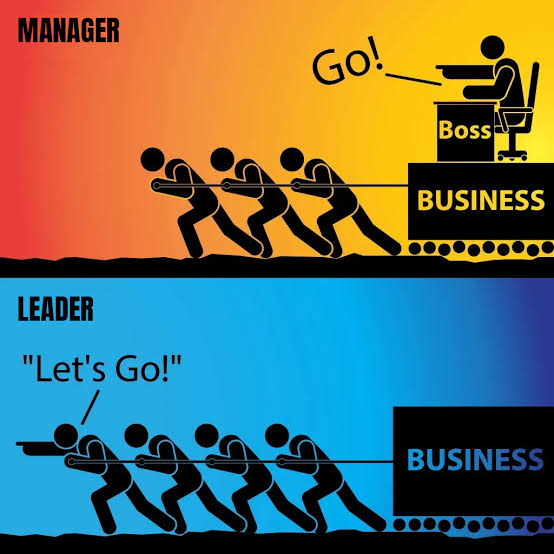
Leading from the front does not mean doing everything yourself. A person who stands with the team must also know when to step back and give someone else the position and opportunity to lead. Otherwise, “I’ll show the way” quickly becomes “only I can do it.”
Management Handles Complexity; Leadership Navigates Change
If a tech lead focuses only on getting work across the finish line, the role can quietly collapse into project management. In his classic Harvard Business Review article “What Leaders Really Do,” John P. Kotter offers a useful distinction:
Management is about coping with complexity; leadership, by contrast, is about coping with change.
Management creates order and predictability through planning, organization, and control. Leadership helps a team find direction amid uncertainty. Neither replaces the other. A team that delivers reliably needs management; a team that can adapt also needs leadership.
For a tech lead, leadership comes down to three capabilities: directional judgment, choosing a path before all the information is available; technical vision, turning scattered judgments into a direction the team can understand; and organizational momentum, translating that vision into roadmaps, engineering practices, and everyday decisions.
Once you own the team’s overall outcome, the unit by which your work is measured changes. You can spend half a day solving a hard problem yourself, solving it with a teammate, or improving the tools and process so that the whole class of problems recurs less often. The first option produces the fastest visible result; the other two compound.
Developing the team is not an extra responsibility. It is the role’s most important source of leverage. Your output is no longer just what you personally finish, but whether the team can make sound decisions, deliver reliably, and keep functioning when you are not in the room.
The 3P Framework: A Map for a Tech Lead’s Attention
Once the role is clear, what deserves attention every day? Three words provide a useful check: Programming, People, and Process.
These are not independent task lists. They are three supports that constrain one another. Programming alone creates a heroic individual and a bottleneck. People without engineering direction can create warmth without traction. Process without judgment buries the team in ceremony. A lead’s time is finite; where attention goes, the team’s shape follows.
Programming: Stay Technically Grounded
Should a tech lead still write code? Yes—and write it personally. Direct contact with code exposes the system’s real complexity, maintenance cost, and the friction shared by the team. Thirty percent can be a useful reference point for a new lead who needs to stay connected, but it is not a KPI. The share can fall as the team matures and rise during exploration or a difficult push.
The question is not whether to code, but why and what to code. Work worth doing personally tends to be exploratory, establish a pattern, or reveal the system’s current reality. Do not permanently own the critical path, and do not retreat into familiar low-risk work simply to look busy. Code review, pairing, and commit history can also keep you connected to the system and the team.
Technical judgment does not mean giving every answer. In a design discussion, it is more valuable to expose the constraints than to say “this won’t work”: expected scale, sustainable maintenance cost, acceptable risk, and reversal cost. A good decision gives an answer and teaches the team how the answer was reached.
Beyond code, several concerns shape engineering behavior: whether standards are actually upheld—for example, whether broken CI is fixed the same day; whether information crosses team boundaries before a risk escalates; whether technical foresight supports the next six months of business change; and whether people feel safe admitting mistakes and asking for help. CI staying red for three days looks like an engineering problem, but it often reveals an ownership and collaboration problem.
People: Humility, Respect, and Trust
“Team Geek” summarizes the foundation of collaboration as HRT: Humility, Respect, and Trust. Engineering effectiveness is never only a function of individual intelligence. It depends on collaboration, which requires admitting that your judgment may be wrong, challenging an idea without belittling its author, and ensuring that people do not regret surfacing a problem.
For a deeply technical lead, the hardest move may be letting go of the need to prove yourself. Someone else knowing more in a particular domain is normal. You do not need to win every debate; you need to help the team find a better answer. Ideas can be challenged sharply while people remain respected. Failure can be fast, provided each failure becomes input to the next decision. Differences in background and perspective are not merely a coordination cost; over time, they are a compounding asset.
One-on-ones should not be used only for status. The ISGS intersection model offers four useful dimensions: Interests, Skills, Goals, and Strengths. Work near their overlap has the best chance of producing motivation, delivery, and growth together. Skill without interest leads toward burnout; interest without skill creates delivery risk. Matching on one dimension is not enough.
Personal growth cannot be separated from organizational purpose. A company must sustain itself, so the healthy outcome is mutual value: people grow while supporting a direction they believe in and creating meaningful value; the organization accumulates long-term capability through their growth. Stating that premise clearly makes career conversations more honest, not less humane.
Process: Give Direction at the Right Time
“Do not do everything yourself” is often misread as abrupt withdrawal: hand over the task, disappear, and intervene only when the result disappoints. Real delegation adjusts support dynamically; it does not jump from control to absence.
Situational Leadership, associated with Paul Hersey and Ken Blanchard, provides a useful vocabulary. The basis for choosing a style is a person’s capability and willingness for this particular task, not seniority or personal closeness:
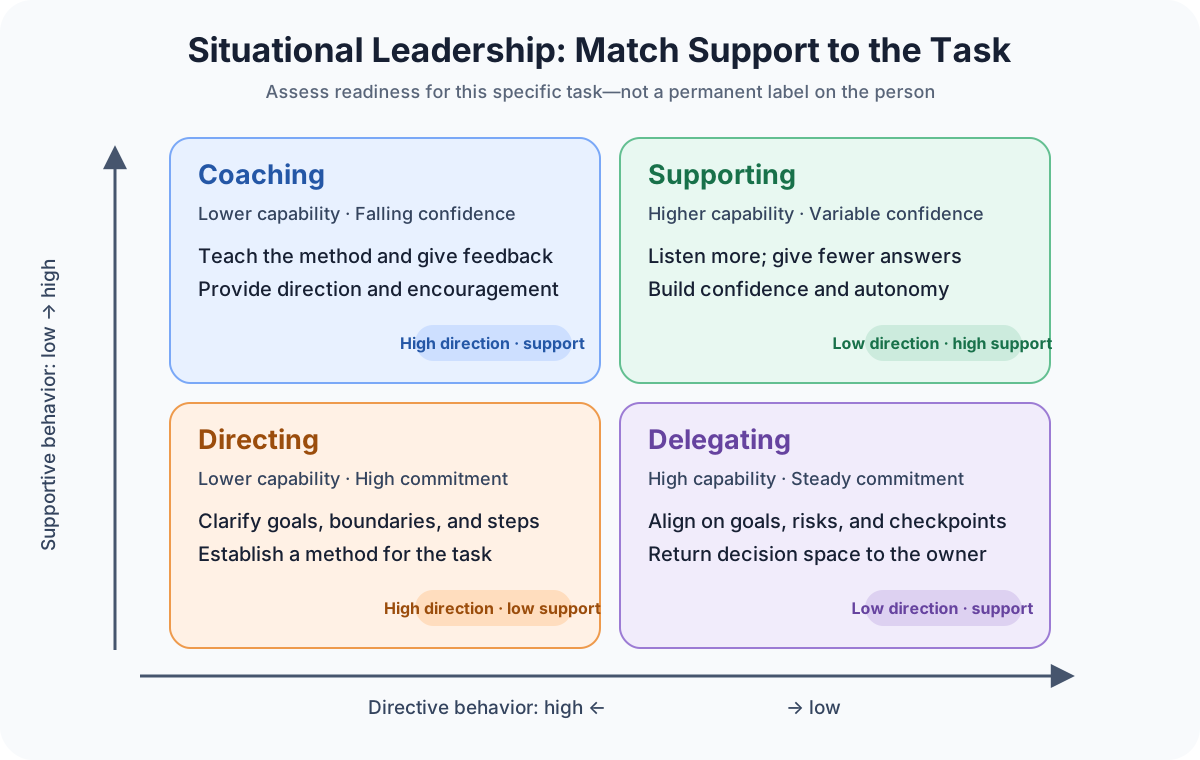
- When someone is taking on this kind of task for the first time, commitment may be high while method and experience are still limited. Use Directing: make goals, boundaries, and steps explicit.
- When someone has begun learning but repeated difficulty has weakened their confidence, use Coaching: teach the method while giving timely feedback and support.
- When someone can complete the work independently but remains unsure of their judgment, use Supporting: give fewer answers, listen, and help them validate their reasoning.
- When someone delivers independently and consistently and is ready to own the outcome, use Delegating: align only on goals, risks, and checkpoints.
Direction is not distrust, and delegation is not abandonment. The same engineer may need only a goal while maintaining a familiar service and frequent alignment while leading a cross-team project for the first time. Readiness is not a permanent label attached to a person; it describes the relationship between a person and a task.
Individuals vary by situation; teams change by stage. Tuckman’s model describes forming, storming, norming, performing, and adjourning. During forming, provide direction and boundaries. During storming, surface conflict and establish rules for handling it. During norming, delegate progressively. During performing, align mainly on goals and risks. During adjourning, reflect seriously and recognize each contribution.
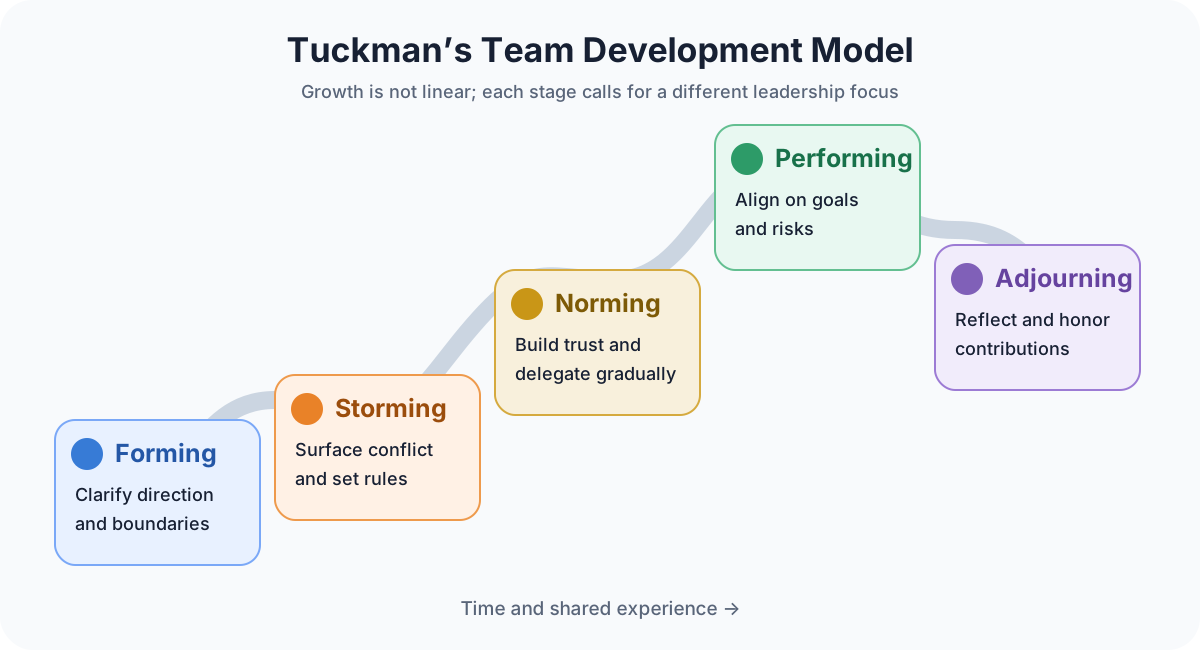
New leads often want to skip storming. Conflict appears and they rush to suppress it, even though much conflict simply shows that the team has begun to collaborate seriously. The goal is not to erase disagreement, but to discuss facts and constraints, clarify decision ownership, commit once a decision is made, and review the outcome. Patience itself is leadership.
Process should reduce uncertainty in collaboration, not force everyone into one method. When is design review mandatory? Which incidents require a retrospective? Who confirms dependencies before release? How are risks escalated? Clear agreements reduce the team’s dependence on last-minute heroics.
Every framework needs a warning label. Statistician George E. P. Box famously wrote:
All models are wrong, but some are useful.
The 3P framework, ISGS, Situational Leadership, and Tuckman are thinking tools, not doctrine. Observe the real person, task, and team before choosing a tool. When reality and the model disagree, trust reality. A model should begin your thinking, never replace it.
From “I’ll Solve It” to “The Team Can Solve It”
The transition into technical leadership does not happen on the day the promotion is announced. It happens through small choices: resisting the impulse to take over when a problem appears; explaining the constraints behind a decision; asking whether a teammate’s mistake came from capability, missing information, or a broken mechanism; and reviewing not just project outcomes but how the team worked together.
If you have just begun leading a team, start with two simple exercises.
First, list the three things for which the team currently depends on you most. Consider which of them can gradually be transferred by developing another person, improving documentation, or changing the process. Second, hold a conversation with each teammate that does not cover project status. Talk only about what they do well, where they want to grow, and what is missing from their current work.
These actions will not make leadership easy overnight, but they reveal the real job. It is not to make yourself irreplaceable. It is to build a team that can keep making sound decisions and delivering reliably even without a hero in the room.
Technical ability still matters. After you become a tech lead, however, technology should no longer remain only a tool in your own hands. It should gradually become a capability shared by the entire team.
Comments